From Tool Calling to Autonomous AI Agents
Move beyond basic prompting and simple tool calling.
Learn how to engineer AI-powered workflows and production-ready agents that can understand goals, select and execute tools, maintain state, make decisions, interact with external systems and involve humans when necessary.
This hands-on specialization takes you through the complete progression:
LLM → Tools → Workflows → State → Agents → MCP → Controlled Autonomy
You will learn how to connect AI systems with REST APIs, databases, business services and external systems, then evolve those workflows into intelligent agents using LangGraph and MCP.
What You’ll Learn
🔧 1. Tool & Function Calling
Learn how LLMs interact with external capabilities through structured tools.
- Tool schemas
- Function contracts
- Parameter extraction
- Parameter validation
- Structured inputs and outputs
- Tool selection
- Tool execution
- Safe tool invocation
- Tool response handling
Understand the complete flow:
User Request → LLM → Tool Selection → Parameters → Tool Execution → Result → LLM
🔄 2. AI Workflow Engineering
Learn how to build structured workflows that combine:
- LLMs
- Tools
- APIs
- Databases
- Business logic
- State
- Human approval
Using LangChain, you’ll learn how to create reusable AI workflows rather than isolated prompts.
🧩 3. Workflow Engineering Patterns
Understand the major patterns used to build reliable AI workflows:
- Sequential workflows
- Parallel execution
- Conditional execution
- Routing
- Branching
- Loops
- Fallback workflows
- Human-in-the-loop (HITL)
- State-based execution
Learn when to use a workflow and when you actually need an agent.
🤖 4. From Workflows to AI Agents
Understand what changes when an AI system moves from a predefined workflow to an agent.
Learn about:
- Goals
- Planning
- Decision-making
- State management
- Tool orchestration
- Agent loops
- Dynamic tool selection
- Controlled execution
- Memory
- Human intervention
Understand the progression:
Fixed Workflow → Dynamic Workflow → Agent
🧠 5. Agent Architecture with LangGraph
Use LangGraph to engineer stateful and controllable AI agents.
Learn:
- Graph-based agent architecture
- State
- Nodes
- Edges
- Conditional routing
- Agent loops
- Tool execution
- Persistence
- Human-in-the-loop
- Multi-step execution
- Failure recovery
Build agents that can follow complex execution paths instead of relying on a single LLM response.
🌐 6. MCP — Model Context Protocol
Understand how MCP standardizes the way AI applications connect to external capabilities.
Learn the MCP architecture:
Host → Client → Server → Tools / Resources
Understand:
- MCP Hosts
- MCP Clients
- MCP Servers
- MCP Tools
- MCP Resources
- Tool discovery
- Tool invocation
- AI-to-system connectivity
🛠️ 7. Build MCP Servers & Tools
Learn how to expose real capabilities to AI systems through MCP.
Build integrations for:
- REST APIs
- Databases
- Business services
- External systems
- Custom application capabilities
Learn how one MCP server can expose reusable capabilities to compatible AI applications and agents.
🔐 8. Secure Tool, Workflow & Agent Execution
Learn how to prevent uncontrolled AI actions.
Cover:
- Authentication
- Authorization
- Permissions
- Tool contracts
- Parameter validation
- Access control
- Human approval
- Controlled execution
- Isolation
- Secure handling of sensitive operations
The goal is controlled autonomy, not unrestricted autonomy.
🛡️ 9. Reliability & Failure Recovery
Production AI systems must handle failure.
Learn:
- State management
- Retries
- Timeouts
- Fallbacks
- Guard conditions
- Error handling
- Tool failures
- Partial execution
- Recovery strategies
- Human escalation
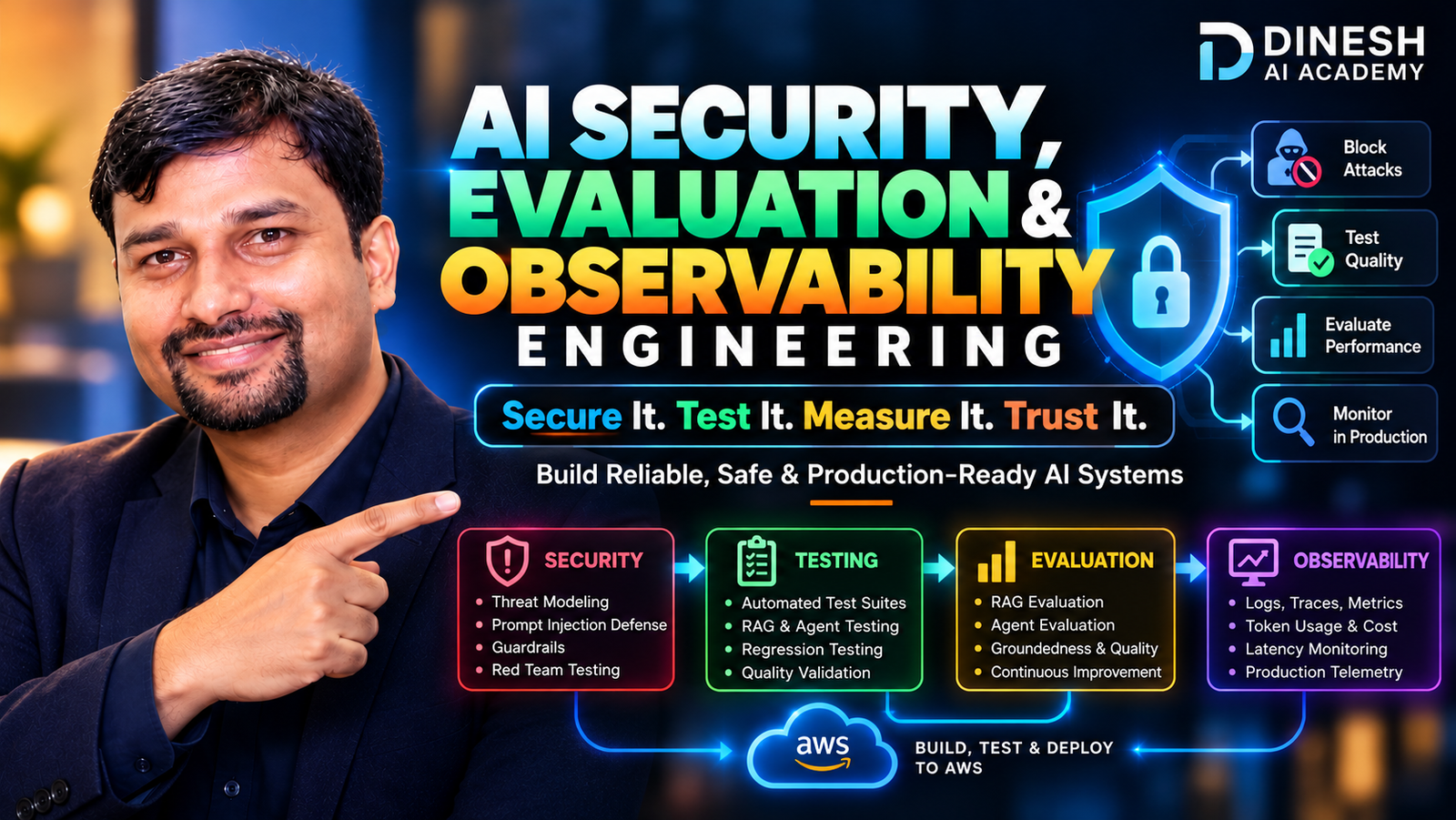
📊 10. Observability & Execution Monitoring
Understand what happens inside an AI workflow or agent.
Learn to monitor:
- LLM calls
- Tool calls
- Execution paths
- State transitions
- Errors
- Latency
- Token usage
- Agent decisions
- Workflow outcomes
Build systems that are observable rather than black boxes.
🤖 11. AI-Assisted Agent Development
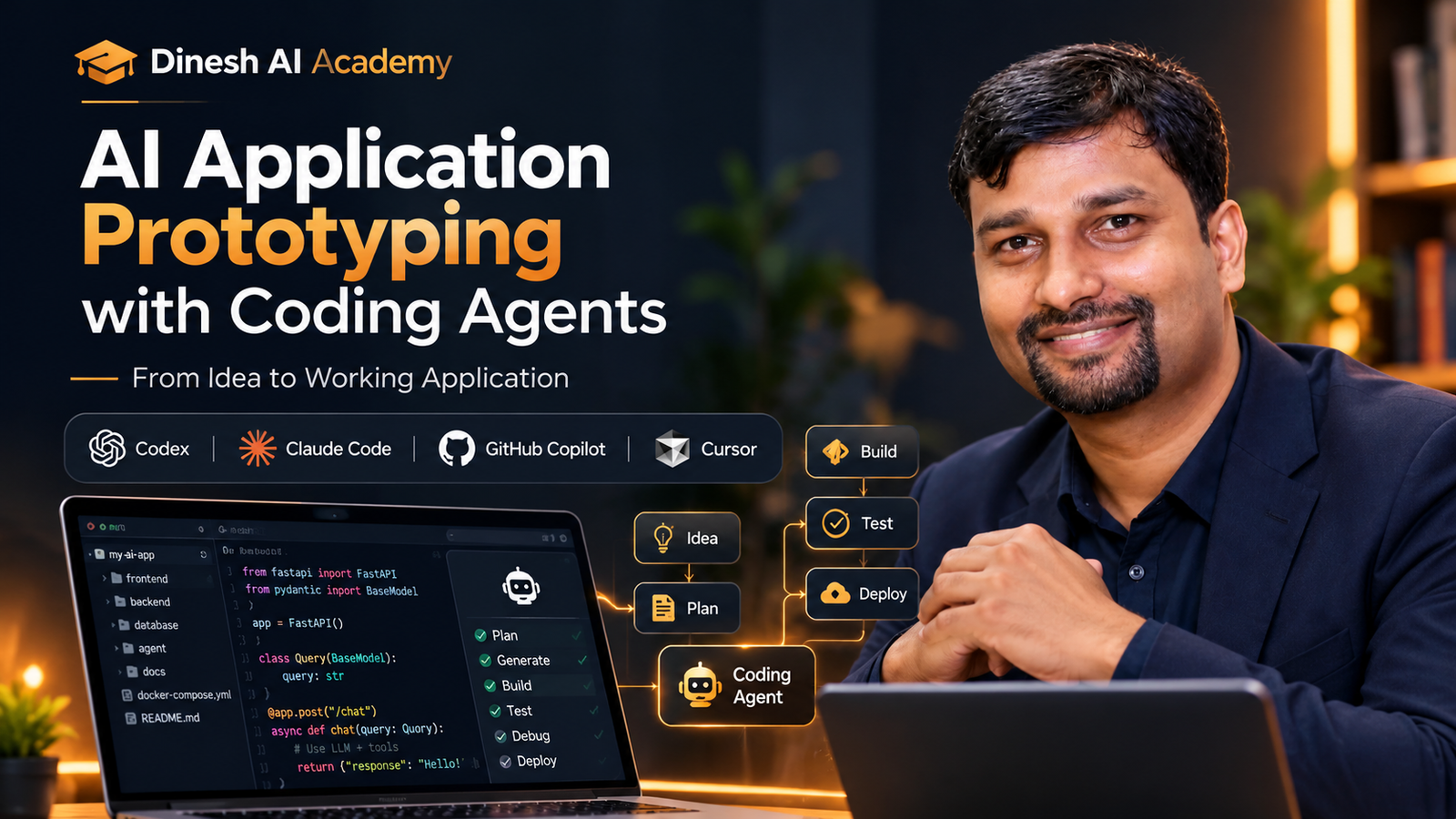
Use modern AI coding agents such as:
OpenAI Codex · Claude Code · GitHub Copilot · Cursor
to accelerate:
- Workflow development
- Agent implementation
- MCP server development
- Debugging
- Testing
- Refactoring
- Optimization
The focus is not simply on generating code, but on using AI coding agents to engineer AI systems faster and more effectively.
🚀 Hands-On Projects
Project 1 — AI Action Workflow
Build v0.3 — Production AI Action Workflow
The system will:
Understand Request → Select Tools → Extract Parameters → Execute Tools → Process Results → Take Next Action → Request Human Approval When Required
Example:
“Check my customer order, verify its status and initiate a refund if it meets the policy.”
The workflow can interact with APIs and business systems while maintaining controlled execution.
Project 2 — AI Agent + MCP Platform
Build v0.4 — Production AI Agent Platform
The agent will:
Understand Goal → Plan → Select Tools → Execute → Observe Results → Decide Next Step → Continue → Complete / Escalate
Using:
LangGraph + MCP + Tools + External Services
The agent can interact with APIs, databases and other external capabilities through MCP.
🎯 Who This Program Is For
Software Developers, AI Engineers, Software Engineers, Tech Leads, Architects, automation developers and experienced technical professionals who want to build AI workflows, tool-using agents and MCP-based systems that can interact with real-world applications.
It is particularly suitable for learners who already understand basic LLM concepts and want to move into AI application orchestration and agent engineering.
🌟 What Makes This Specialization Different?
This is not simply a:
“Learn Function Calling” course.
And it is not just:
“Build a chatbot with an agent.”
You will learn the engineering progression:
Tools
AI can use external capabilities.
↓
Workflows
AI capabilities can be orchestrated into reliable execution paths.
↓
Agents
AI can dynamically decide what to do next.
↓
MCP
AI systems can connect to standardized external capabilities.
↓
Controlled Autonomy
Agents can execute multi-step tasks while respecting permissions, guard conditions and human approval.
🎓 What You’ll Walk Away With
By the end of the specialization, you will understand how to:
- Design tool/function-calling systems
- Build reusable AI workflows
- Implement sequential, parallel and conditional workflows
- Connect LLMs with APIs and databases
- Understand the difference between workflows and agents
- Build stateful agents with LangGraph
- Implement planning and multi-step agent execution
- Build and consume MCP servers
- Expose APIs and business capabilities through MCP
- Implement human-in-the-loop execution
- Handle tool and agent failures
- Apply permissions and controlled execution
- Add observability to AI workflows
- Use AI coding agents to accelerate development
- Build and deploy AI workflow and agent applications
The Outcome
Move from simple LLM applications to intelligent systems that can use tools, execute workflows, interact with external systems and autonomously complete multi-step tasks—with appropriate human control.