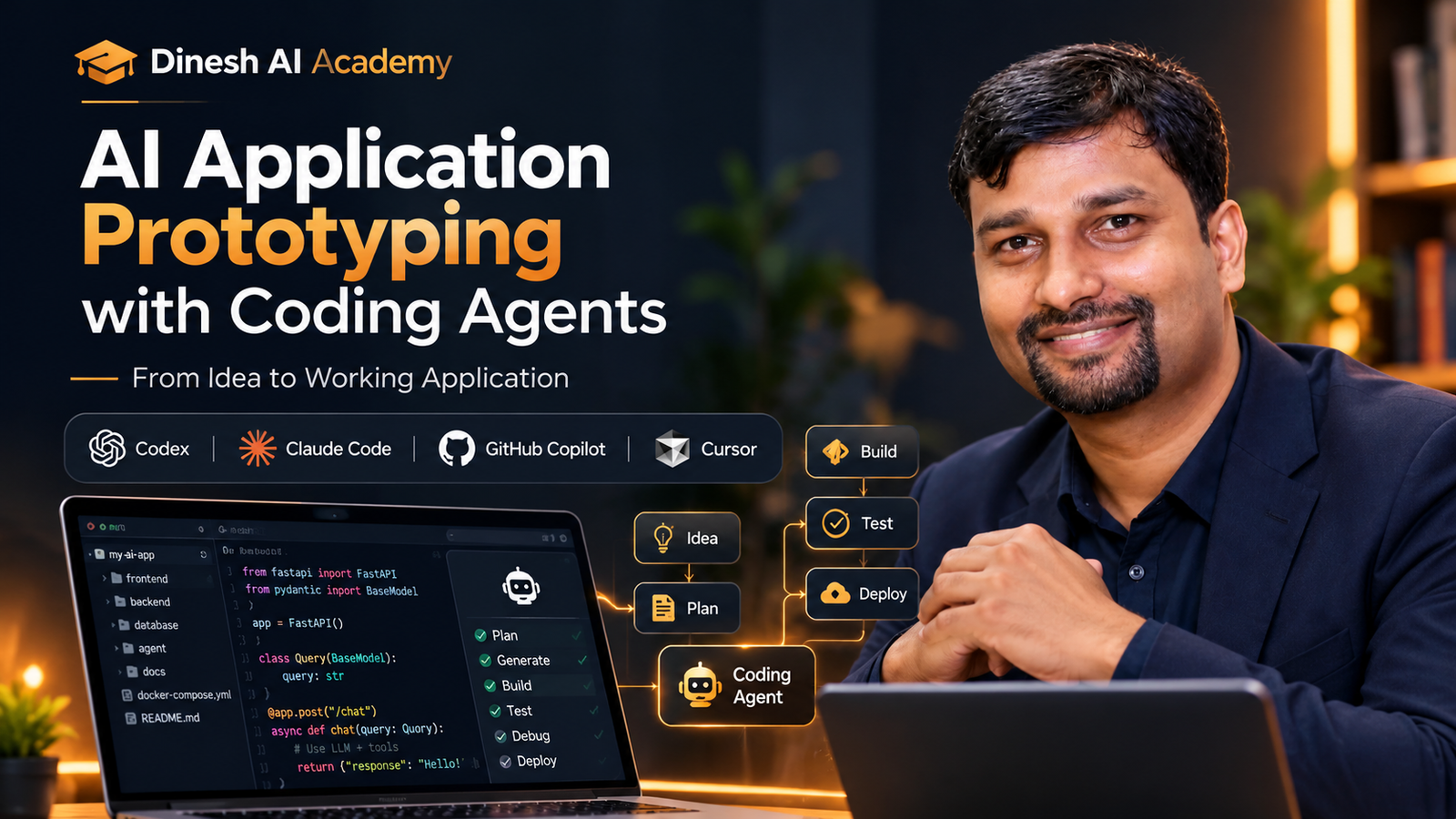
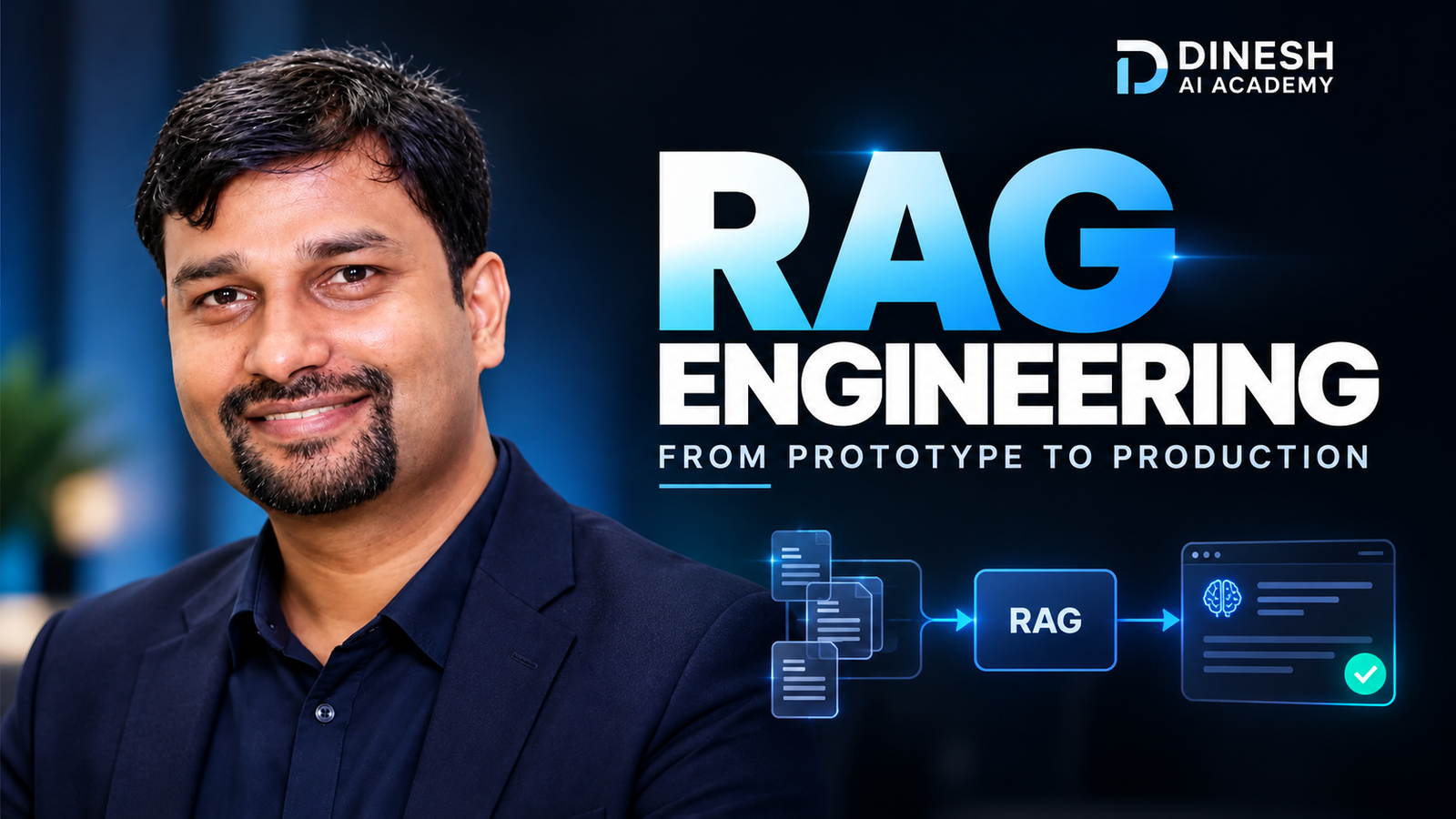
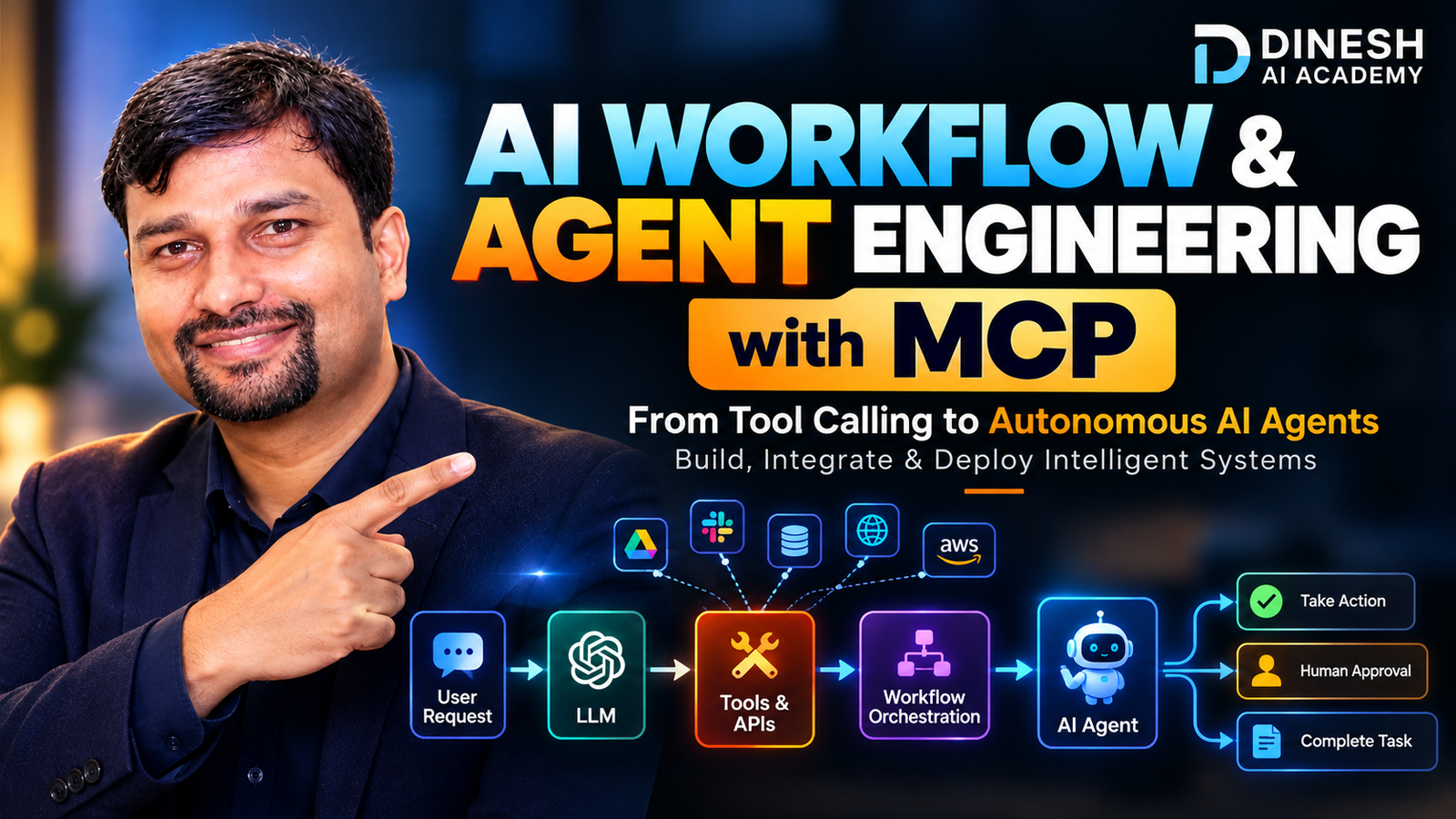
One real agentic app, shipped in week one and improved every week with RAG, tools, agents, MCP, memory, guardrails and evaluation. You build it the way enterprise teams do, with Claude, GitHub Copilot, Azure DevOps and AWS, and by Demo Day it runs on a public URL.
Weeks 1 · AI-Powered Full-Stack Engineering & Project Mastery (v.01)
Build, understand, document, and prototype real-world production applications using AI Agents + Angular + FastAPI + PostgreSQL + LLMs.
- Build a production-grade AI full-stack application from scratch using Angular, FastAPI, PostgreSQL and OpenAI/Claude/Gemini—with AI agents supporting the complete SDLC: Requirements, Architecture, Technology Selection, Development, Code Review, Testing, DevOps and Security
- AI-assisted engineering with GitHub Copilot, Claude Code and Codex — use AI effectively for requirements, coding, debugging, refactoring, testing and documentation while maintaining engineering quality
- Understand complex existing applications quickly — discover the business domain, architecture, technology stack, workflows, integrations, key functionalities and dependencies needed to customize, maintain and support an enterprise project
- Create world-class project documentation for an existing application so that Product Owners, Architects, Business Analysts and Developers can understand the system, business flow, architecture, technology and functionality with minimal onboarding time
- Rapidly convert client requirements into working POCs/prototypes using AI-assisted engineering—validate ideas, demonstrate solutions and accelerate client discussions.
- Production engineering fundamentals — API design, database modeling, error handling, security, testing, Git/GitHub workflow, CI/CD with Azure Pipelines and AWS deployment
- Engineering documentation — requirements as Azure Boards stories, architecture decisions as ADRs, technical documentation and project knowledge base
Hands-on project: Build and deploy a production-ready AI full-stack application to AWS, reverse-engineer and document a complex existing project, and create a rapid client POC using AI-powered engineering workflows.
Weeks 2 · LLM + RAG Engineering: Production RAG (v0.2)
Engineer a production-grade RAG system that grounds LLM responses in enterprise knowledge—designed for relevance, accuracy, traceability and scale, not a basic vector-search demo.
- LLM Engineering — model selection, token economics, context windows, structured outputs, inference patterns and cost/performance optimization
- Knowledge & Context Engineering — instruction hierarchy, context optimization, query understanding, query rewriting and reliable grounding
- Enterprise Data → AI Knowledge — ingest documents and business data, clean and transform content, metadata design, document processing and knowledge pipelines
- Advanced Retrieval Engineering — chunking strategies, embedding models, semantic search, metadata filtering, hybrid search, reranking and retrieval optimization
- Production RAG Architecture — vector databases, retrieval pipelines, citations, source attribution, access control and scalable architecture
- RAG Quality & Reliability — hallucination controls, relevance evaluation, answer faithfulness, retrieval evaluation, observability and failure analysis
- AI-assisted RAG development — use AI coding agents to build, debug, optimize and test the complete knowledge pipeline
Hands-on project: Build and deploy v0.2 — a production-ready Enterprise AI Knowledge Assistant that ingests a real knowledge base and delivers grounded, traceable and citation-backed answers. Build, test and deploy v0.2 to AWS.
Week 3 · AI Tools & Workflow Engineering (v0.3)
Engineer reliable AI-powered workflows that connect LLMs to real-world tools, APIs, databases and enterprise systems—moving beyond simple prompting and tool calling to structured, observable and production-ready execution.
- Tool & Function Calling — tool schemas, function contracts, parameter validation, structured inputs/outputs and safe execution
- AI Workflow Orchestration — use LangChain to connect models, tools, memory and business logic into reusable workflows
- Workflow Engineering Patterns — sequential, parallel, conditional, routing, branching, loops and human-in-the-loop (HITL) execution
- Production Tool Engineering — reusable tool interfaces, authentication, permissions, idempotency, retries, timeouts and failure recovery
- Real-World Integrations — connect AI applications with REST APIs, databases, business services and enterprise systems to retrieve information and perform actions
- Reliable AI Execution — tool selection, validation, state management, error handling, fallback strategies and controlled execution
- AI-assisted workflow development — use AI coding agents to design, implement, test, debug and optimize complex workflows
- Production Observability & Security — logging, tracing, execution monitoring, access control and secure handling of tool actions
Hands-on project: Build and deploy v0.3 — a production-ready AI Action Workflow that understands a user request, selects the right tools, executes multi-step actions, handles failures and incorporates human approval where required. Build, test and deploy v0.3 to AWS.
Week 4 · AI Agents & MCP Engineering — Autonomy (v0.4)
Design and engineer production-grade AI agents that can understand goals, plan tasks, maintain state, reason over context, orchestrate tools and securely interact with external systems through MCP.
- Agent Architecture — goals, planning, state management, memory, tool orchestration, decision-making and controlled execution
- LangGraph for Agent Engineering — build stateful, multi-step, conditional and event-driven agent workflows with reliable execution paths
- Advanced Agent Patterns — routing, planning, reflection, reasoning loops, human-in-the-loop (HITL), supervisor agents and multi-agent orchestration
- MCP Architecture & Engineering — understand Hosts, Clients, Servers, Tools and Resources and how MCP enables standardized AI-to-system connectivity
- Build MCP Servers & Tools — expose APIs, databases, business capabilities and external services as reusable tools for AI agents
- Secure Agent & MCP Integration — authentication, authorization, permissions, tool contracts, validation, isolation and secure execution
- Agent Reliability & Failure Recovery — state persistence, retries, timeouts, fallbacks, guard conditions and controlled autonomy
- AI-assisted Agent Development — use AI coding agents to design, implement, test, debug and evolve complex agent systems
Hands-on project: Build and deploy v0.4 — a production-ready AI Agent Platform using LangGraph + MCP that can understand a goal, plan and execute multi-step tasks, orchestrate multiple tools, interact with external services and involve a human when required. Build, test and deploy v0.4 to AWS.
Weeks 5 · AI Security, Guardrails & Responsible AI Engineering (v0.5)
Engineer secure, controlled and production-ready AI systems with defense-in-depth protection across prompts, data, inputs, outputs, tools and autonomous agents.
- AI Security & Threat Modeling — identify attack surfaces, trust boundaries, data-flow risks, sensitive information exposure and realistic AI abuse scenarios
- Prompt Injection & Jailbreak Defense — protect against direct prompt injection, jailbreak attempts and indirect injection through documents, web content, tools and external data
- Input Security & Guardrails — input validation, sanitization, content filtering, PII detection/protection, policy enforcement and malicious-input handling
- Output Guardrails — schema validation, content filtering, groundedness checks, response validation and controlled output policies
- Agent & Tool Security — authentication, authorization, least-privilege access, tool permissions, sandboxing and controlled execution
- Data & Enterprise AI Security — protect sensitive data across RAG, LLM calls, vector databases, APIs, logs and agent workflows
- AI Safety & Responsible Engineering — build systems with transparency, traceability, human oversight, predictable behavior and responsible-use controls
- Security Testing & Red Teaming — deliberately attack the AI system, identify vulnerabilities, validate defenses and continuously improve security controls
Hands-on project: Harden v0.5 — the production AI agent with enterprise-grade security and guardrails. Perform AI red-team testing, attack it against real-world threats, fix vulnerabilities and validate the complete security layer. Build, test and deploy v0.5 to AWS.
Weeks 6 · AI Evaluation, Testing & Observability Engineering (v0.6)
Build an evaluation-driven AI engineering system where quality, reliability, safety and performance are continuously measured, tested and improved—not assumed from a successful demo.
- AI Application Testing — unit, integration, API, regression and end-to-end testing for LLM, RAG, workflow and agent-based applications
- AI-Specific Testing — deterministic checks, structured test suites, edge cases, adversarial scenarios and automated regression testing
- RAG Evaluation — measure retrieval quality, relevance, context quality, faithfulness, groundedness and overall answer quality
- Agent Evaluation — evaluate task success, tool selection, execution trajectory, decision quality, reliability and failure patterns
- Evaluation-Driven Development — create evaluation datasets, quality criteria, benchmarks and automated evaluation pipelines to measure every change
- Production Observability — implement logs, traces, metrics, latency monitoring, token usage, model performance, error rates and end-to-end AI telemetry
- Cost & Performance Engineering — monitor inference cost, token consumption, response latency and system performance to identify optimization opportunities
- Continuous AI Quality — detect regressions, analyze failures and continuously improve prompts, models, retrieval, tools and agent workflows
Hands-on project: Build v0.6 — an automated AI Evaluation & Observability Platform that benchmarks the RAG and agent systems, runs automated test/evaluation suites, tracks quality and performance metrics, analyzes failures and provides production telemetry. Build, test and deploy v0.6 to AWS.
Weeks 7 · Docker, Cloud & DevOps Engineering
Transform the complete AI platform into a portable, reproducible and production-ready cloud workload with containerization, automated delivery, secure infrastructure and operational controls.
- Docker & Container Engineering — multi-stage builds, image optimization, networking, volumes, environment configuration, secrets and secure container practices
- Production Containerization — containerize the Angular frontend, FastAPI backend, AI services, workers and supporting components with consistent development and production environments
- CI/CD Engineering — automate build, testing, security scanning, image publishing, deployment and post-deployment validation
- Cloud Architecture — AWS & Azure — understand compute, networking, storage, databases, container platforms and managed cloud services required for AI workloads
- Production Configuration & Secrets — environment management, secure configuration, secret management, health checks, readiness checks and service dependencies
- Scalability & Reliability — horizontal scaling, load balancing, resource management, fault tolerance, rollback and recovery strategies
- Production Monitoring & Operations — application health, logs, metrics, alerts, deployment verification and operational troubleshooting
- AI-Assisted DevOps — use AI coding agents to generate Docker configurations, CI/CD pipelines, deployment scripts, troubleshoot failures and accelerate cloud operations
Hands-on project: Containerize the complete AI platform, implement a production-grade CI/CD pipeline, configure cloud infrastructure and automated deployment, and validate the application through health checks, monitoring and rollback strategies. Build, test and deploy v0.7 to AWS/Azure as a production-ready cloud workload.
Weeks 8 · Production Readiness, Capstone & Graduation (Certification)
Take the complete AI platform through a final production-readiness gate and demonstrate the ability to design, build, secure, test, deploy and operate a real-world AI system.
- Final Quality Assurance — functional, integration, regression, performance, reliability and end-to-end validation across the complete platform
- Security & Compliance Review — vulnerabilities, secrets, permissions, access controls, threat-model verification, guardrails and security hardening
- AI Quality & Evaluation — validate RAG and agent performance for accuracy, groundedness, reliability, safety and production acceptance criteria
- Production Readiness Review — identify and resolve critical issues across architecture, code quality, infrastructure, security, performance and operations
- Complete Technical Documentation — architecture, APIs, database design, AI/RAG/agent workflows, deployment guide, troubleshooting guide, runbooks and operational documentation
- Production Release Engineering — release management, versioning, deployment validation, rollback readiness and final production sign-off
- Technical Assessment — defend the architecture, engineering decisions, technology choices, trade-offs, security controls and production implementation
- Capstone Demo & Graduation — demonstrate the complete AI platform end-to-end and showcase the engineering journey from requirements → architecture → development → RAG → workflows → agents → security → evaluation → cloud deployment → production
- Certification — earn the Advanced AI Engineering Program Certificate upon meeting the defined program completion and technical assessment criteria
Hands-on project: Complete the final production-readiness gate, resolve critical findings, finalize all technical documentation, and release v1.0 to AWS/Azure. Present the complete capstone, defend the technical implementation and complete the final assessment, graduation and certification.